Evaporator Coil Leaks: Causes, Warning Signs, and Long Term Solutions
In high demand environments such as manufacturing floors, data centers, healthcare facilities, and processing plants, capacity loss is not a minor comfort issue. It can seriously impact production or operations. In this guide, the experts at CS Coil explain what causes an evaporator coil leak, how to identify the warning signs, and the best solutions.
Top 5 Causes of Evaporator Coil Leaks in Commercial Systems
An evaporator coil leak in a commercial system typically develops over time. The failure is usually the result of one or more of the following:
1. Formicary Corrosion in Copper Tube Systems
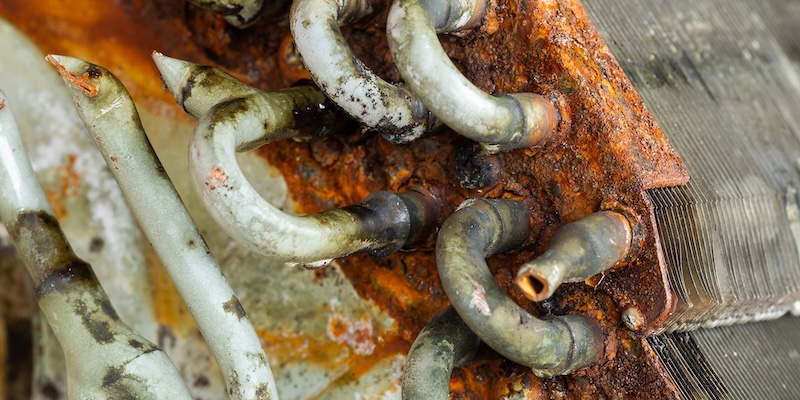
Formicary corrosion is common in copper tube coils. Airborne contaminants combine with moisture on the coil surface and create acids that attack the copper. This results in “tunneling” or microscopic pinholes that often appear in clusters, making them nearly impossible to patch effectively. Once it starts, it rarely affects only one location.
Buildings with cleaning chemicals, newer construction materials, or certain process vapors can accelerate this type of corrosion.
2. Vibration & Mechanical Fatigue
It’s understood that large air handlers and rooftop units operate with constant vibration. So if the coil is not properly supported, or if piping places stress on the headers, metal fatigue will develop over time. Return bends and brazed joints are common weak points. Repeated thermal expansion and contraction adds additional stress. After enough cycles…a crack finally forms, and refrigerant escapes.
3. Airflow Imbalance & High Face Velocity
If air doesn’t move evenly across the coil, the refrigerant inside doesn’t boil correctly. This can create uneven temperatures that will cause the metal to expand/contract at different rates, leading to stress cracks.
Additionally, if the air is moving too fast (High Face Velocity), it can cause the delicate copper tubes to vibrate against the aluminum fins. Over several years, this constant rubbing acts like sandpaper, thinning the tube walls until a leak develops.
4. Freeze Events
Low airflow, low refrigerant charge, or control issues can cause coil surface temperatures to fall below freezing. Ice formation then places mechanical stress on the tubing and fin pack. If freeze and thaw cycles repeat, any existing weak points can open up. In many cases, a freeze event does not create a brand new problem, on the other hand, it is exposing one that had already started.
5. Manufacturing or Design Limitations
Last but not least, many leaks happen because the replacement coil was chosen based only on its physical size. If a coil has walls that are too thin or a circuiting layout that doesn’t match the system’s power, it will almost certainly fail prematurely.
Common Warning Signs of an Evaporator Coil Leak
Most evaporator coil leaks develop gradually. The system might continue operating as if nothing is wrong, but performance will start to decline over time. Common warning signs include:
- Gradual loss of cooling capacity in zones served by the air handler
- Repeated refrigerant additions during service visits
- Oil residue visible at coil headers, return bends, or distributor connections
- Low suction pressure readings
- Nuisance low pressure or freeze protection alarms
- Ice formation on portions of the coil during partial load conditions
Note: A refrigerant leak is a performance issue. If you see water on the floor, it’s usually a secondary symptom of the coil icing up and melting, not the refrigerant itself.
Why “Topping Off” is a Trap: Topping off refrigerant is a temporary patch that fails to address the mechanical root cause, leading to unstable compressor conditions and poor oil return. If you are adding refrigerant more than once in a short period, you are ignoring a mechanical failure that requires corrective action.
Can an Evaporator Coil Leak Be Repaired?
Many evaporator leak cases involve multiple small failures caused by corrosion or fatigue. Repairing one location does not stop the next weak point from opening. Not to mention, sealants carry risk to metering devices and oil quality. Access inside air handlers can also limit repair quality.
It is for this reason that in most industrial applications, evaporator coil replacement is more predictable than repeated repair attempts.
Note: A single visible crack at a braze joint can sometimes be repaired. However this is not that common of a scenario in commercial equipment.
When an Evaporator Coil Leak Signals a Larger System Decision
An evaporator leak can also serve as a decision point for the entire HVAC system. Sometimes, replacing only the coil may not provide the best return on investment.
If the compressor has high operating hours, if the air handler shows structural deterioration, or if the system uses phased-out refrigerant, this may point more toward system replacement.
If you find yourself in this situation, consider the following:
- Age of the compressor / remaining service life
- Condition of the air handler cabinet, components
- Refrigerant type and longterm availability
- Energy performance (compared to current standards)
Read more: AC Coil Replacement vs. Full Unit Replacement
How You Can Prevent Future Evaporator Coil Leaks
Not every failure can be prevented, but certain practices reduce risk! Here’s what you can do:
- Inspect airflow and static pressure during commissioning and after major changes
- Maintain proper filtration and replace filters consistently
- Inspect coils for buildup and clean as needed
- Confirm vibration isolation and piping support
- Track refrigerant charge and document service history
Note: Maintenance does not reverse corrosion that has already started. It does however reduce the likelihood of early coil failure
CS Coil: Performance-Proven Replacement Evaporator Coils
CS Coil delivers engineered OEM evaporator and condenser coil replacements built for commercial and industrial equipment. We’re a trusted microchannel coil manufacturer of condenser coils, fluid coolers, and AC replacement coils, protective coil coatings and more. All products are designed to meet or exceed original performance requirements and operating conditions.
Contact us today to learn more.