What is an Outdoor Coil in HVAC? How Condenser Coils Work
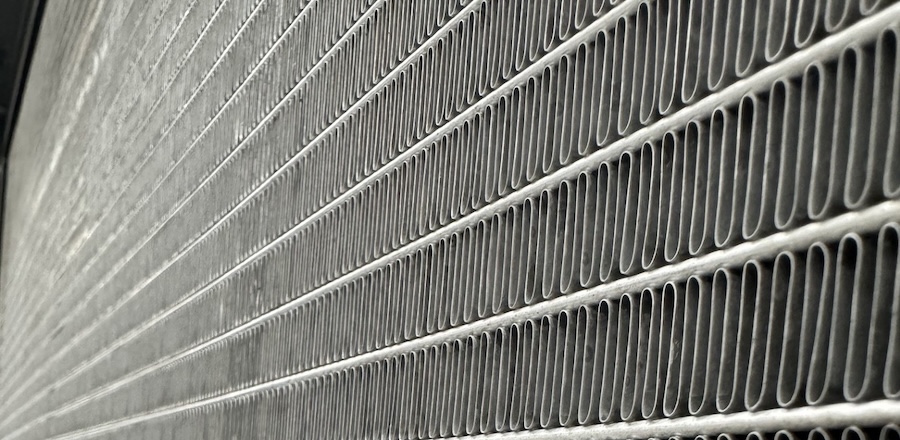
In commercial HVAC, an outdoor coil is the heat exchanger installed in the outdoor section of an air-conditioning, refrigeration or heat pump system. During cooling, it removes heat from the refrigerant and releases it into the outdoor air.
What is an Outdoor Coil?
Outdoor coils are used in packaged rooftop units, split commercial systems, air-cooled chillers, condensing units and heat pumps.
The coil is made up of refrigerant circuits, tubing, fins, headers and connections. Its size and construction have to match the equipment capacity, refrigerant and operating conditions.
In a standard cooling system, the indoor coil absorbs heat from the building or process. The compressor raises the refrigerant pressure and sends that heat to the outdoor coil, where it is released.
How Does an Outdoor Coil Work?
The process works in four basic steps.
1. Hot refrigerant enters the coil
The compressor sends hot, high-pressure refrigerant vapor into the outdoor coil. Compressing the refrigerant raises its pressure and temperature.
2. Heat leaves the refrigerant
An outdoor fan moves air across the coil surface. Heat transfers from the refrigerant, through the tubing and fins, and into the surrounding air.
The coil needs enough surface area and airflow to reject the required heat. That depends on the equipment capacity, refrigerant, entering air temperature and available space.
3. The refrigerant condenses
As heat leaves the refrigerant, it reaches its condensing temperature and changes from a vapor into a high-pressure liquid. The liquid then moves toward the expansion valve or another metering device.
4. The cycle continues
The expansion device lowers the refrigerant’s pressure and temperature. The refrigerant enters the indoor coil, absorbs heat and returns to the compressor as a vapor.
That process repeats as long as the system is running.
How Does an Outdoor Coil Work in a Heat Pump?
In a standard cooling system, the outdoor coil functions as the condenser coil. “Outdoor coil” refers to where the coil is located. “Condenser coil” refers to what it is doing during cooling.
A heat pump is different because the refrigerant flow changes direction.
During cooling mode, the outdoor coil rejects heat and functions as the condenser. During heating mode, a reversing valve changes the refrigerant flow. The outdoor coil absorbs heat from the outdoor air and functions as the evaporator. The indoor coil then releases that heat into the building.
What Affects Outdoor Coil Performance?
Coil design and circuiting
Tube diameter, fin spacing, circuit arrangement and refrigerant distribution all affect heat transfer and pressure drop.
The coil needs enough surface area for the load, but size is not the only concern. Refrigerant also has to move through the circuits properly. Poor circuiting can restrict flow or create uneven performance across the coil.
Airflow and outdoor conditions
Blocked discharge air, damaged fan blades, incorrect fan rotation or a failing motor can reduce outdoor coil performance. Dirt, grease and debris can also restrict the passages between the fins.
Outdoor temperature affects the coil as well. When ambient temperature rises, there is less temperature difference available for heat rejection. Condensing temperature and compressor operating pressure may rise, especially when the system is already operating near its design limit.
Corrosion and coil construction
Outdoor coils are exposed to moisture, chemicals, salt air and other conditions that can cause corrosion. Corrosion may damage fins, tubes and headers and can eventually lead to refrigerant leaks.
Microchannel and tube-and-fin coils are both used in outdoor applications. Microchannel coils can provide high heat-transfer performance in a compact, lightweight design with low refrigerant volume. Tube-and-fin construction may be a better fit for other equipment based on the refrigerant, service conditions, corrosion exposure and replacement requirements.
When Does an Outdoor Coil Need to Be Replaced?
High head pressure alone does not prove that the outdoor coil is faulty. Fan performance, airflow, refrigerant charge and system load should be checked before deciding that the coil needs to be replaced.
Replacement may be needed when the coil has widespread corrosion, non-repairable leaks or damaged tubes and headers. It may also make sense when the original coil is obsolete, no longer meets the equipment’s capacity requirements or is not available within the required lead time.
Before ordering a replacement coil, confirm:
- Equipment model and serial number
- Refrigerant type and required capacity
- Airflow
- Coil dimensions
- Connection sizes and locations
- Circuiting information
- Fin material and coating requirements
- Available space and mounting details
Cabinet dimensions alone are not enough to select a replacement coil. Operating data, drawings and photographs can help confirm the requirements before fabrication begins.
Need a Replacement Outdoor Coil? Contact CS Coil Today!
CS Coil manufactures commercial HVAC replacement coils for leaking, corroded, obsolete or underperforming equipment. Our team can review the application and help identify a replacement outdoor coil for your system.
Send us your equipment specifications, coil drawings or available dimensions to request a custom quote.