What’s the Difference Between Microchannel Coils vs. Regular Coils?
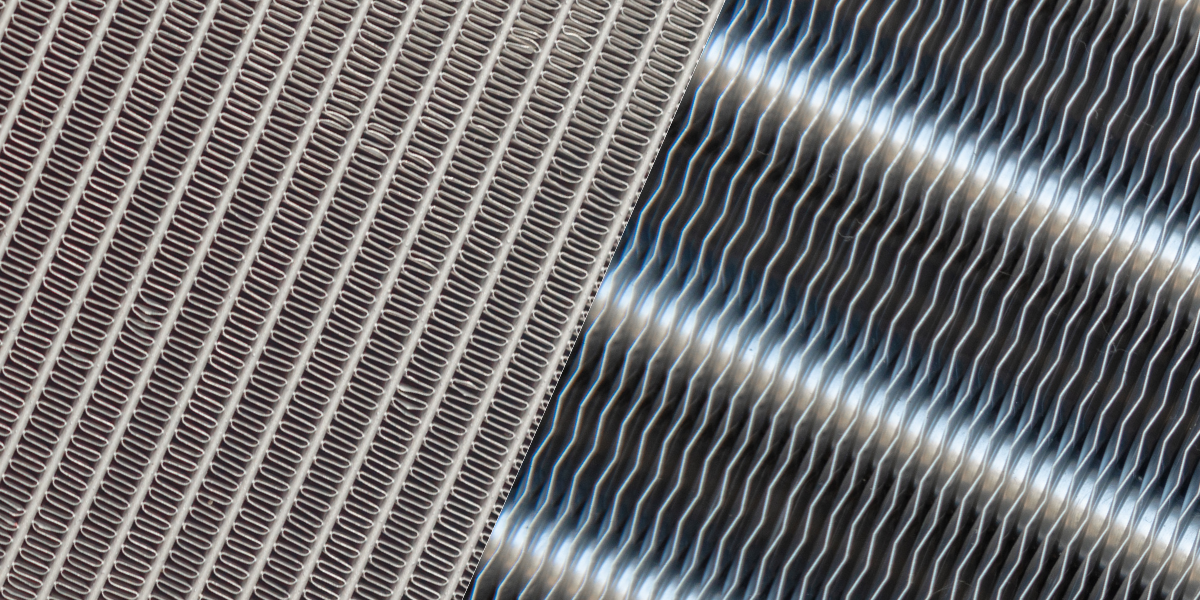
Over the past decade, microchannel coils have moved from being viewed as niche or automotive derived to being widely used across HVAC, refrigeration and process cooling. Below is a comparison guide of microchannel coils vs. regular coils, written by people who design and manufacture them!
Regular Coils: Traditional Round-Tube Plate-Fin
Round-tube plate-fin coils have been used in HVAC and refrigeration systems for decades, mainly due to familiarity and availability. These coils use copper tubes mechanically expanded into aluminum fins and are usually arranged in multiple rows to meet capacity needs.
This design also carries built in limits. Mechanical tube-to-fin contact restricts heat transfer, larger tube diameters increase internal volume and refrigerant charge, and the use of both copper and aluminum introduces corrosion risk in harsher environments.
Modern Coils: Microchannel Technology
Microchannel heat exchangers (MCHE) were first developed for the automotive industry more than 30 years ago, where weight reduction, material use and packaging were driving factors. When the technology was adapted for HVAC, early designs were often scaled automotive coils and that approach fell short.
Early HVAC microchannel coils dealt with refrigerant maldistribution, condensate bridging, higher pressure drop and uneven part-load behavior. Manufacturing equipment at the time also wasn’t suited for the larger surface areas required by HVAC systems.
Modern microchannel coils are the result of reworking both design and production. HVAC-specific coils use flat, multiport aluminum tubes brazed to aluminum fins in controlled atmosphere brazing (CAB) furnaces built for large-format coils. Tube orientation, fin geometry, header design and alloy selection have been refined to suit HVAC operating conditions.
Today, microchannel coils are built not only as condensers, but also as direct expansion evaporators, heat pump coils, water coils and process cooling heat exchangers, with predictable behavior across full-load and part-load operation.
Read more: What is a Microchannel Coil?

Design Details
From a manufacturing standpoint, the largest difference between microchannel and finned-tube coils is how heat transfer takes place. Microchannel coils use flat tubes with multiple small internal ports rather than a single round passage. This raises the surface-area-to-volume ratio and keeps more refrigerant near the tube walls, where heat transfer occurs.
In a microchannel coil, tubes, fins and headers are brazed together, forming a metallurgical bond that removes tube-to-fin contact resistance. This accounts for much of the efficiency gain compared to mechanically assembled finned-tube coils.
Header design varies by application. DX cooling and heat pump evaporators use internal distribution features to feed refrigerant evenly across the coil. Condenser coils can be built with receiver-style headers to stabilize liquid flow and reduce sensitivity to charge variation. Water coils use larger headers to keep waterside pressure drop low and flow even.
Microchannel coils are commonly built with vertical tube orientation, which improves condensate drainage and reduces moisture bridging between fins.
Performance / Efficiency
The combination of brazed construction, small hydraulic diameters and louvered fin geometry leads to higher heat transfer on both the refrigerant and air sides. In practice, this allows microchannel coils to deliver required capacity in a smaller, lighter package or higher capacity within the same footprint.
Airside pressure drop is another area where microchannel coils perform well. Compared to multi-row finned-tube coils of similar capacity, microchannel designs typically show lower airside resistance. Reduced pressure drop lowers fan energy use, reduces noise and gives more flexibility in airflow design.
These characteristics also allow closer approach temperatures between air and refrigerant, which becomes more valuable as efficiency targets continue to tighten.
Microchannel Coils vs. Regular Coils: Comparison Chart
| Feature | Microchannel Coils | Traditional Coils |
| Primary Materials | All-aluminum construction | Copper tubes with aluminum fins |
| Tube Geometry | Flat tubes with multiple micro-sized ports | Single large-diameter round tubes |
| Tube-to-Fin Connection | Brazed metallurgical bond | Mechanical expansion/contact |
| Heat Transfer Efficiency | Higher | Lower |
| Airside Pressure Drop | Lower | Higher in multi-row designs |
| Refrigerant Charge | Lower | Higher |
| Corrosion Risk | Lower due to single-metal construction | Higher due to mixed metals |
| Weight and Size | Smaller and lighter | Larger for similar capacity |
| Part-Load Behavior | Predictable with current designs | Less flexible |
| Maintenance | Thin profile, simple cleaning | Familiar service methods |
Read more: What is the Difference Between a Microchannel Coil vs. Copper Coil?
Refrigerant Charge / Environmental Impact
Internal volume affects refrigerant use. Microchannel coils contain less refrigerant than finned-tube coils due to smaller internal passages. As systems move toward lower-GWP refrigerants with higher cost and tighter charge limits, this reduction becomes more attractive at the system scale.
Lower refrigerant charge also reduces environmental exposure if a leak occurs. Fewer joints compared to finned-tube coils further reduce leak potential.
Durability, Corrosion Resistance, Maintenance
Traditional coils combine copper and aluminum, which can lead to galvanic corrosion in marine, industrial or chemically aggressive settings. All-aluminum microchannel coils remove that risk by design.
Modern microchannel coils also use improved aluminum alloys and protective coatings such as e-coating, which has long been used in automotive and industrial applications. These coatings slow corrosion and extend service life in demanding environments.
Microchannel coils are not difficult to maintain. Their thin profiles often make cleaning easier and routine maintenance usually involves low-pressure water and mild cleaning solutions.
Installation / Service Reality
From an installation standpoint, microchannel coils don’t require unusual procedures. Good brazing practice, nitrogen purging, proper evacuation and accurate refrigerant charging apply to any HVAC system.
Because microchannel coils use fewer joints, there are fewer potential leak points. When service is needed, working with the coil manufacturer helps align repair methods with the coil design.
Cost / Application Fit
Microchannel coils often allow systems to meet performance targets using less material, less refrigerant and lower airflow resistance. In many current HVAC and refrigeration applications, this leads to lower total system cost once energy use, refrigerant rules and operating expenses are factored in.
As requirements continue to tighten around energy use, refrigerant charge and environmental exposure, coil designs that meet those demands with fewer compromises are becoming more common.
Consult CS Coil for Expert Coil Selection Guidance
Microchannel coils have changed a lot over the years and when they’re designed for the application, they tend to fit modern system needs better. That’s where CS Coil focuses its work. We design and build microchannel coils every day, along with condensers, evaporators and fluid coolers.
Contact the CS Coil team to speak with a coil specialist today